
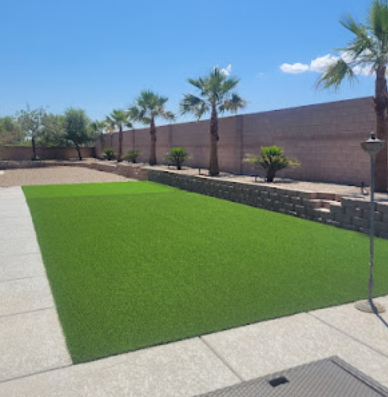
The retaining wall options Las Vegas homeowners choose from usually come down to two materials: CMU block and natural rock. Both do the same fundamental job — holding back soil on a grade change, preventing erosion, and creating usable flat space in a yard that would otherwise slope — but they look completely different and suit different situations. Retaining walls come up more often in Las Vegas backyards than homeowners expect, since much of the valley was graded with sloped lots and elevation changes between properties, and a wall is often the most practical way to reclaim that sloped area as usable yard space. Here’s how to tell which one fits your property.
CMU Block Wall vs. Rockery Wall
| Factor | CMU Block Wall | Rockery Wall |
|---|---|---|
| Appearance | Clean, uniform, modern — can be stuccoed or veneered to match the house | Natural, textured, blends into desert landscaping |
| Best For | Straight runs, taller walls, modern or transitional yards | Sloped lots, curved layouts, natural or xeriscape-style yards |
| Installation Time | Generally faster for long, straight sections | Slower — each stone is placed and fitted individually |
| Structural Strength | Highly consistent, engineered to code for taller walls | Strong for moderate height, engineering-dependent for taller walls |
| Maintenance | Very low — occasional resealing if finished | Very low — natural stone doesn’t fade or crack easily |
| Permit Threshold | Required over a certain height per Clark County code | Required over a certain height per Clark County code |
When to Choose a CMU Block Retaining Wall
A CMU block retaining wall is usually the right call when you need a taller wall, a perfectly straight run, or a finish that can be stuccoed and painted to match your home’s exterior. Because the blocks are uniform, engineering for taller walls is more predictable, which matters once you’re above the height where Clark County requires an engineered permit set. CMU walls are also a strong choice if you want a modern, architectural look rather than a natural stone aesthetic. Many homeowners also choose CMU when the wall needs to double as a planter, seat wall, or backdrop for an outdoor kitchen, since the flat, uniform surface is easier to build around than irregular stone.
When to Choose a Rockery Retaining Wall
A rockery retaining wall makes more sense on sloped or irregular lots, or anywhere you want the wall to look like it belongs in a desert landscape rather than standing out as a built structure. Rockery walls pair especially well with xeriscaping and native plantings, and they hold up extremely well in the Las Vegas climate since natural stone doesn’t crack or fade the way lower-grade materials can under constant sun exposure. Because each stone is set individually, a rockery wall can also step and curve to follow uneven terrain in a way that a straight-run CMU wall generally can’t match without additional engineering.
If you’re weighing a full backyard redesign around a new retaining wall, our backyard makeover ideas guide covers how walls fit into a broader layout.
What Goes Into Building a Retaining Wall
Regardless of material, every retaining wall starts with excavation for a footing below the frost-free depth required by code, followed by a compacted gravel base that gives the footing a stable foundation. Steel reinforcement is typically set into the footing and, for taller CMU walls, run vertically through the block cores and filled with grout for added strength. Backfill material and compaction behind the wall matter just as much as the wall itself — improperly compacted backfill is one of the leading causes of wall failure over time, regardless of whether the face is CMU or natural stone. For taller walls, or walls supporting a driveway, patio, or structure above them, an engineer typically specifies the exact footing depth, steel reinforcement, and backfill material required, and that engineering is what gets submitted with the Clark County permit application.
Drainage Behind a Retaining Wall
Every retaining wall needs a way for water to escape from behind it, or hydrostatic pressure will eventually push the wall out of alignment. This usually means a perforated drain pipe wrapped in gravel and filter fabric running along the base of the wall, tied into weep holes or a discharge point. This detail is easy to overlook but is one of the main things separating a retaining wall that lasts decades from one that starts leaning within a few years.
Permits and Height Limits
In Clark County, retaining walls above a certain height require a permit and engineered drawings before construction begins, and footings must be inspected before concrete is poured. Both CMU and rockery walls fall under the same permitting rules once they cross that threshold. You can review the Clark County fence and block wall permit guide for the specific thresholds and application requirements.
Maintenance for Both Wall Types
Both CMU and rockery retaining walls require very little ongoing maintenance compared to most other hardscape elements. CMU walls with a stucco or painted finish may need touch-ups every several years as the finish weathers under constant sun exposure, though the underlying block structure itself is extremely durable. Rockery walls essentially require no maintenance at all — natural stone doesn’t need resealing, repainting, or any protective coating, which is part of why many homeowners find them appealing beyond just the aesthetic. The one thing worth checking periodically on any retaining wall, regardless of material, is the drainage system behind it — a clogged weep hole or drain line is usually the first sign of a developing problem, and it’s far easier to clear a blocked drain than to repair a wall that’s already shifted.
Terra Green Landscape holds a C-18 Masonry license (#0083155) under TGL Nevada Corp, in addition to our C-10 Landscape (#0082671) and C-5 Concrete (#0083156) licenses, so we handle the wall, the grading behind it, and any surrounding hardscape as one project. We’ve built retaining walls across Las Vegas, Henderson, Summerlin, and Boulder City for 25+ years, on everything from flat backyards needing a small planter wall to sloped lots needing a full engineered rockery system.
Not Sure Which Wall Fits Your Yard?
Get a free estimate and an honest recommendation from a licensed Las Vegas masonry contractor.
Get a Free EstimateFrequently Asked Questions
What retaining wall options Las Vegas homeowners have for sloped lots?
Rockery walls built from stacked natural stone are typically the better retaining wall option for sloped or irregular lots in Las Vegas, since individual stones can follow the contour of the land more easily than uniform CMU block.
Do retaining walls in Las Vegas require a permit?
Yes, once a retaining wall exceeds a certain height, Clark County requires a permit and engineered drawings before construction, along with a footing inspection before concrete is poured.
Which is more durable in Las Vegas heat, CMU block or rockery walls?
Both hold up well in the Las Vegas climate. CMU block is engineered and highly consistent, while natural stone in a rockery wall resists fading and cracking from constant sun exposure without needing a protective finish.
Can a retaining wall be combined with landscape lighting or planting beds?
Yes, both CMU and rockery retaining walls are commonly built with integrated planting beds or low voltage lighting to highlight the wall and the grade change it creates.
Is Terra Green Landscape licensed to build retaining walls in Las Vegas?
Yes. Terra Green Landscape holds C-18 Masonry #0083155 under TGL Nevada Corp, along with C-10 Landscape #0082671 and C-5 Concrete #0083156, covering retaining wall construction across the Las Vegas metro area.