
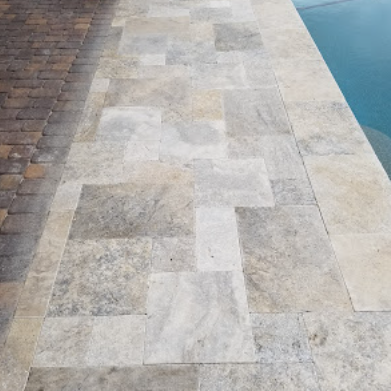
Choosing the right pool coping options Las Vegas pools need can make or break the finished look of your backyard. Coping is the material that caps the edge of the pool shell, and it does more than look good — it’s what your feet touch every time you get in or out, and it’s what protects the pool structure from water intrusion behind the shell. In a climate that regularly hits triple digits, the material you choose matters more here than almost anywhere else in the country.
What Pool Coping Actually Does
Coping serves three jobs at once: it caps and protects the top edge of the pool wall, it creates a clean transition between the water and the deck, and it gives you a non-slip surface to walk on wet. Cheap or poorly installed coping shows up as cracking, staining, or a surface that gets dangerously hot by mid-morning in July. It also plays a structural role that’s easy to overlook — coping shields the bond beam and the top of the pool shell from direct water and sun exposure, and when it fails or lets water intrude behind it, the damage often isn’t visible until it’s already affecting the pool structure underneath. That combination of visible wear and hidden structural importance is why coping shouldn’t be treated as a purely cosmetic decision.
Common Pool Coping Materials in Las Vegas
Travertine Coping
Travertine is the most popular pool coping material we install in the Las Vegas valley, and for good reason — its natural porosity keeps it noticeably cooler underfoot than concrete or pavers, even in direct summer sun. It’s naturally slip-resistant, comes in a range of tumbled and honed finishes, and pairs well with almost any pool deck material behind it. The tradeoff is that natural stone costs more upfront than poured concrete, though most homeowners find the heat comfort alone justifies the difference once they’ve lived with it through a full summer.
Brick Paver Coping
Paver coping gives you a huge range of color and pattern options, and it’s easy to match to an existing paver patio or driveway for a consistent look across the whole property. Pavers hold up well to heat cycling and are simple to replace individually if one ever cracks or stains, without disturbing the rest of the pool edge. This makes paver coping a practical choice for homeowners who want long-term flexibility to repair or update sections over time.
Cast (Poured) Concrete Coping
Poured concrete coping, often finished with a broom or light texture for slip resistance, is the most budget-friendly option and works well for homeowners who want a clean, simple edge. It can be tinted or stamped to reduce heat absorption, but on its own it runs hotter underfoot than travertine or pavers in peak summer. Concrete coping is often chosen for pools with simple, geometric shapes where a continuous poured edge looks more intentional than segmented material.
Natural Stone Coping
Beyond travertine, other natural stones like flagstone give a more rustic, textured look. Natural stone is durable and visually distinct, but it typically requires more careful installation to keep a consistent, safe walking surface since the material isn’t as uniform as cut travertine or manufactured pavers. It tends to suit backyards with a broader natural stone theme already established in retaining walls or planting beds.
How Pool Coping Installation Works
Coping installation starts with the pool shell’s bond beam — the structural edge the coping material anchors to. A mortar or mud bed is set along this edge, and each coping piece is leveled and set so the finished surface has a consistent overhang past the pool wall, typically with a slight slope away from the water to help drainage. Once set, joints between pieces are grouted or sealed to keep water from working underneath the coping over time, which is one of the most common causes of coping failure when installation is rushed. This is also the stage where the coping meets whatever deck material surrounds it, so the two need to be planned together rather than installed by separate crews on separate timelines.
How to Choose the Right Coping for Your Pool
A few questions usually settle it:
- Do you want the coping to match or contrast with the rest of your pool deck?
- How much heat and slip resistance do you need for how your family actually uses the pool?
- What’s the overall style of your backyard — modern, desert natural, or traditional?
- Are you replacing coping on an existing pool, or building a new one from scratch?
There’s rarely a single “correct” answer — it’s a balance between budget, how the space gets used, and how the coping ties into the rest of the backyard design. If you’re also deciding on the deck material surrounding the coping, our guide on stamped concrete vs. travertine pool decks breaks down that comparison in more detail, and our pavers vs. concrete comparison covers the broader hardscape decision.
Maintaining Pool Coping Over Time
Coping maintenance varies by material but is generally light across the board. Travertine and natural stone benefit from periodic sealing to guard against staining from sunscreen, pool chemicals, and hard water deposits, though the stone itself doesn’t fade or degrade from sun exposure. Poured concrete coping should be resealed on a regular schedule to maintain both its color and its slip resistance, since an unsealed surface can become more porous and prone to staining over time. Brick pavers hold up well with minimal attention, though joint sand between pieces may need occasional replenishing. Regardless of material, it’s worth rinsing coping periodically to clear away pool chemical residue and mineral buildup before it has a chance to etch or discolor the surface.
Terra Green Landscape is licensed as C-10 Landscape #0082671 and C-5 Concrete #0083156, which means we handle both the coping and the surrounding deck under one crew. We’ve installed pool hardscape across Las Vegas, Henderson, and Summerlin for 25+ years, and pool coping work in particular tends to involve permitting and structural considerations worth reviewing on Clark County’s building code page before you finalize a scope.
Ready to Upgrade Your Pool Deck?
Get a free estimate on pool coping and deck materials from a licensed Las Vegas contractor.
Get a Free EstimateFrequently Asked Questions
What are the best pool coping options Las Vegas homeowners should consider for heat?
Travertine is generally considered the best pool coping option for Las Vegas heat because its natural porosity keeps the surface noticeably cooler underfoot than concrete or standard pavers, even in direct summer sun.
How much does pool coping cost compared to the rest of a pool deck?
Coping cost varies by material and the linear footage around your pool. Wade and the Terra Green team assess each pool in person to give an accurate number, since material choice and pool shape both affect the total.
Can pool coping be replaced without redoing the whole pool deck?
In many cases, yes — coping can be removed and replaced along the pool edge without tearing out the full surrounding deck, though the scope depends on how the original coping was installed and tied into the deck material.
Is travertine pool coping slippery when wet?
No, travertine is naturally slip-resistant even when wet, which is part of why it’s a popular choice for pool areas where people are frequently walking with wet feet.
Does Terra Green Landscape install both pool coping and the surrounding deck?
Yes. As a licensed C-10 Landscape and C-5 Concrete contractor (TGL Nevada Corp), Terra Green Landscape installs pool coping and deck hardscape together for homes across the Las Vegas metro area.