
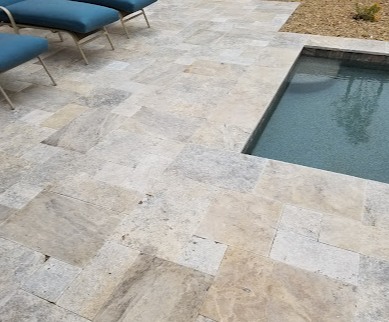
Picking the right pool deck materials Las Vegas summers can handle comes down to heat, slip resistance, and style. A pool deck sees more direct sun exposure and bare feet than almost any other surface on your property, which makes the material decision more important here than for a standard patio. Homeowners who’ve lived through a full Las Vegas summer with an under-performing pool deck — one that’s too hot to cross barefoot by mid-morning — tend to prioritize heat performance on their next project even above style preferences. Here’s how stamped concrete and travertine compare.
Stamped Concrete vs. Travertine Pool Decks
| Factor | Stamped Concrete | Travertine |
|---|---|---|
| Heat Retention | Runs hotter underfoot in direct summer sun, even with lighter colors and sealers | Naturally cooler underfoot due to its porous structure — the biggest advantage in Las Vegas heat |
| Slip Resistance | Textured finish provides good grip when properly sealed | Naturally slip-resistant, even when wet |
| Upfront Cost | Generally the more budget-friendly option | Higher upfront cost as a natural stone material |
| Style Options | Wide range of stamped patterns and color tints available | Natural stone variation, tumbled or honed finishes |
| Maintenance | Periodic resealing recommended to maintain color and slip resistance | Low maintenance, resists fading and staining over time |
| Longevity | Long-lasting when properly sealed and maintained | Extremely long-lasting, natural stone doesn’t degrade with UV exposure |
Why Heat Matters More Than Almost Anything Else
In a climate where pool decks routinely see surface temperatures well above the air temperature during summer months, how a material handles heat isn’t a minor detail — it’s often the deciding factor. Travertine’s natural porosity means it doesn’t absorb and hold heat the way dense stamped concrete does, which is why so many Las Vegas homeowners choose it specifically for pool areas, even at a higher upfront cost. Color also plays a role independent of material — darker tints and finishes absorb more heat than lighter ones regardless of whether the surface is concrete or stone, which is why light desert tones are the default recommendation for any pool deck in the valley, even when a homeowner prefers a darker look elsewhere in the yard.
When Stamped Concrete Still Makes Sense
Stamped concrete remains a strong choice for homeowners who want a specific pattern or color scheme, need to stay within a tighter budget, or are matching an existing concrete patio elsewhere on the property. With a quality sealer and proper maintenance schedule, a stamped concrete pool deck can perform well for many years. It’s also a practical choice for larger pool decks, where covering more square footage in natural stone would meaningfully raise the project cost.
When Travertine Is Worth the Investment
Travertine tends to make the most sense for homeowners who use their pool deck heavily during peak summer months, have young children who spend a lot of time barefoot around the pool, or want a more upscale, resort-style finish. Because the heat difference is so noticeable in person, many homeowners who initially plan to save money with concrete end up choosing travertine once they’ve experienced a Las Vegas pool deck in July firsthand.
Cool-Deck Coatings and Other Ways to Reduce Heat
For homeowners set on stamped concrete, cool-deck coatings and lighter color tints can meaningfully reduce surface temperature compared to standard concrete, though they typically won’t match travertine’s natural cooling performance. These coatings also add texture that improves slip resistance, and they can be reapplied during routine resealing to keep the deck performing and looking like new.
Slip Resistance Matters as Much as Heat
Pool decks are wet more often than any other hardscape surface on the property, which makes slip resistance a genuine safety consideration rather than just a comfort detail. Both materials can be finished for strong slip resistance — textured stamping for concrete, and tumbled or brushed finishes for travertine — but a smooth or over-polished finish on either material can become dangerously slick when wet, so finish selection matters as much as the base material choice.
If you’re also deciding on coping to pair with your deck material, our guide to pool coping options in Las Vegas covers how the edge treatment factors into the overall look and feel.
Permits and Pool Deck Construction
Pool decks and the surrounding hardscape are typically included in the overall pool permit, but any changes to an existing pool area, including deck replacement, should be confirmed against current Clark County building code requirements before work begins.
Maintenance Schedule for Both Materials
Stamped concrete typically needs resealing every two to three years in the Las Vegas climate, since constant UV exposure breaks down sealers faster here than in milder climates — skipping resealing accelerates fading and reduces slip resistance over time. Between resealing, occasional cleaning to remove sunscreen residue, mineral deposits, and general grime keeps the surface looking fresh. Travertine requires far less frequent attention; sealing every few years helps guard against staining, but the stone itself doesn’t need resealing to maintain its structural integrity or color the way concrete does. For both materials, addressing small cracks or chips early prevents them from spreading, particularly given how much thermal expansion and contraction Las Vegas pool decks go through between summer highs and winter nights.
Terra Green Landscape installs both stamped concrete and travertine pool decks under our C-5 Concrete license (#0083156) and C-10 Landscape license (#0082671), and we’ve built pool decks across Las Vegas, Henderson, and Summerlin for 25+ years.
Not Sure Which Pool Deck Is Right for You?
Get a free estimate and a straight answer on which material fits your budget and your backyard.
Get a Free EstimateFrequently Asked Questions
Which pool deck materials Las Vegas homeowners should pick for the coolest surface?
Travertine is the pool deck material that stays coolest underfoot in Las Vegas, thanks to its naturally porous structure, which is why it’s often preferred over stamped concrete for pool areas with heavy bare-foot use.
Is stamped concrete a good option for a Las Vegas pool deck?
Yes, stamped concrete is a durable and budget-friendly option for a Las Vegas pool deck, though it does run hotter underfoot than travertine during peak summer months.
How long does a travertine pool deck last?
Travertine is extremely durable and resists fading, cracking, and UV degradation, which allows a well-installed travertine pool deck to last for decades with minimal maintenance.
Does stamped concrete need to be resealed regularly?
Yes, periodic resealing is recommended for stamped concrete to maintain its color, texture, and slip resistance over time, especially given constant sun exposure in Las Vegas.
Can I mix stamped concrete and travertine on the same pool deck?
Yes, some homeowners combine materials — for example, travertine coping with a stamped concrete field — to balance cost and heat performance across the deck.
Is Terra Green Landscape licensed to install pool decks in Las Vegas?
Yes. Terra Green Landscape holds C-5 Concrete #0083156 and C-10 Landscape #0082671 under TGL Nevada Corp, covering pool deck installation across the Las Vegas metro area.